

How to Organise Clothes in a Wardrobe 2025
Updated October 2025 to include winter wardrobe tips and seasonal storage ideas.
Quick Summary:
Struggling with a cluttered wardrobe as winter approaches? This updated guide shares expert tips on decluttering, arranging by category, and maximising space with smart storage solutions. Whether you're preparing your winter wardrobe or refreshing your space for the new year, these practical hacks will help you stay organised and cosy all season long.
Whether you have a single clothes rail or a whole walk-in wardrobe, organising and storing your clothes properly can save you time and space.
We’ve put together some tips on how to sort out your clothes and accessories so that they’re tidy, easy to find, and not all scrunched up in a ball. This will take a bit of time: perhaps an hour, perhaps half a day, depending on how many clothes you own, and depending on how many tips you want to follow from our list below.
Once you’ve decided how to arrange your clothes in your wardrobe and they are all beautifully organised, you can either choose to redo this process every few months, or develop some habits that will keep your wardrobe organised all year round. If you decide you’d like to maintain your newly organised wardrobe rather than have it descend into crumpled chaos once more, we’ve got some more tips on how to keep your clothes tidy for the long term.
Tip 1: Start with a good clear out.
Over time, our tastes and body size can change. Our wardrobes may become permanent homes to clothes that used to fit, clothes that used to be in style, and clothes that just aren’t comfortable anymore.
Your first task, therefore, is to think about which clothes you’ll actually wear and separate them from ones that you won’t. The easiest way to do this is to empty your wardrobe and consider each piece of clothing critically and dispassionately.
Put to one side any clothes that no longer fit; clothes you don’t like anymore; and clothes that you haven’t worn for at least a year (not just because you’ve forgotten about them, but that you haven’t had occasion to wear).
You have a choice with what to do with those clothes.
A. You can sell unwanted clothes, or give them to charity.
Sell or donate any clothes you are certain you won’t wear again, if you think someone else might get some use out of them.
If any of your unwanted clothes are not in a good enough condition to donate or sell, you can find clothing recycling banks in most supermarket car parks. Charities can sell old fabric by weight to industries that will recycle them and use them (e.g. to manufacture mattresses).
B. You can store infrequently used clothes.
You might not need or want some of your clothes now, but might do in future. Perhaps you’ve got a suit that you wear for interviews, but you’re currently settled in your job. Maybe you’ve got a favourite outfit that you wear on special occasions such as weddings and Christenings, but don’t have any of those events coming up in the foreseeable future. If there are clothes that can still serve a function but spend 99.99% of their time languishing in your wardrobe, it’s best to store them elsewhere.
You could pop them into vacuum storage bags, suck the air out (to minimise the amount of space they take up) and keep them on top of your wardrobe or under your bed. Or, if you’re following the tips below and decide to rent a self storage unit, you could keep them there where they can be kept on hangers and you won’t have to iron them when you next want to wear them.
Since you’ve gone to the trouble of emptying your wardrobe to organise it, you might want to consider investing in some nice matching coat hangers so that your wardrobe looks coordinated and curated. Your old coat hangers can be recycled at your local recycling plant, or some charity shops welcome donations of coat hangers to display clothing for sale.
Tip 2: Organise your clothing by season
Once you’re left with only the clothing that you’ll definitely wear, you can think about how to arrange your clothes in your wardrobe. Even after you’ve disposed of your unwanted or ill-fitting clothing, you might have too many clothes to hang neatly in a way that you can see everything at a glance. So the next thing to consider is, when will you wear these clothes?
If you’re in the UK, it might be better to think of clothing in terms of being suitable for different types of weather, rather than for different seasons, since our seasons are all over the place at the moment. On the whole, we get three types of weather:
- Wet and cold: suitable clothing includes thick trousers / 200 denier tights; thermal vests; long-sleeve tops; coats; boots; thick socks; hats, gloves and scarf.
- Wet and warm: suitable clothing includes dresses; shorts; ¾ length trousers; t-shirts; short-sleeve tops; waterproof jacket; waterproof shoes; umbrella.
- Baking hot: suitable clothing includes shorts; t-shirts; sandals; sunhats; swimming costumes/trunks; summer dresses; lightweight trousers.
Separate your clothes into those that suit each type of weather.
Depending on the prevailing weather at the moment, keep the clothing that is most likely to be suitable for the next, say, 12 weeks. Those are the clothes that need to be kept in your wardrobe where you can access them on a day-to-day basis.
The rest need to be put into vacuum storage bags or folded/hung up in storage. If you have a spare room where excess clothing can be kept, that’s ideal. If not, consider renting a self storage unit: we offer indoor cupboards or rooms that you can rent for 2 weeks at a time, and you can take things out or put more things in whenever you like. If you plan to store them in cardboard boxes rather than hang them on a rail (you can get free cardboard boxes from all sorts of places) make sure the boxes are clearly labelled so you know which ones need to come out of storage when the weather changes again.
If there are any crossover items (that would suit different types of weather), these will be able to spend longer periods in your wardrobe and less time in storage.
If you’re storing clothing, make sure it is clean and completely dry before doing so, to avoid condensation or mould ruining them over time.
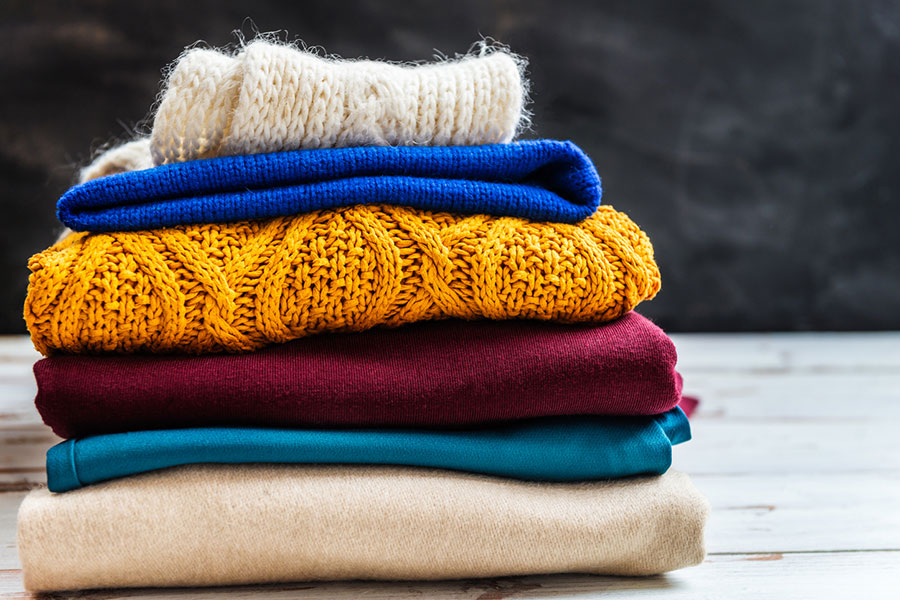
Winter wardrobe tips: When packing away your summer clothes, fold them loosely and store them in breathable fabric bins or plastic boxes with lids to prevent dust and moisture. For your winter wardrobe, hang bulky coats on sturdy hangers and keep knitwear folded to maintain its shape. Layering pieces such as thermal tops, lightweight jumpers, and scarves should be kept at eye level so you can mix and match easily during cold snaps.
Tip 3: Organise your clothes by type
Once you have whittled down the amount of clothing that will be kept handy in your wardrobe, you can choose what order to hang your clothes in. The first way you could do this would be to organise it by what category of clothing it is.
For example, group all your tops together at one end of your rail; hang your trousers / shorts together at the other; and hang your jumpers and cardigans in the middle. Shoes can be grouped according to type as well: work shoes; trainers; boots; going-out shoes; slippers / comfy shoes.
If you have long dresses, trousers or jumpsuits, these should be kept at the far end of the rail, so that you can - if you have space - install a 2-drawer chest of drawers beneath your shorter hanging clothes to store things like underwear, pyjamas or shoes.
Accessories such as scarves / gloves / hats / sunglasses can be kept in clearly marked boxes on top of (or in the bottom of) your wardrobe, or hung on hooks screwed to the inside of your wardrobe doors.
Organising your clothing by type will help you to choose coordinating outfits. For instance, if you feel like wearing jeans, you can easily flick through your t-shirts or tops to choose one that’s the right length or colour without having to push past your dresses or jumpers.
Tip 4: Organise your clothes by colour
If you want to go a step further, you can organise each type of clothing by colour. How you do this is up to you - you might want to order your jumpers by colour from dark to light, or group together individual colours (e.g. greens, blues, reds) together. Given that you’ll probably choose what to wear based on colour on any given day, this is a good way to organise your clothes to speed up your morning routine.
Tip 5: Habits to stay organised
Keep an eye on the weather patterns. You’ll know from experience that when the weather starts to change there’s a different ‘feel’ to the air, or even a different scent. Prepare to swap out your clothes for ones that suit warmer or colder weather; if you’ve chosen to use self storage, this is easy enough to do as you can just call into your unit during opening hours (we are open 7 days a week, every day of the year) and swap your current clothes for ones better suited to the new weather.
During winter, it’s worth taking an extra few minutes each month to air out stored clothes and check for damp or moths. You can also pop a few cedar wood blocks or lavender sachets among your stored items to keep them fresh until spring.
If you notice that you don’t wear a particular pair of trousers or top very often, reevaluate whether you just don’t like it anymore and consider donating or selling it.
If you buy new clothes, consider instigating a ‘one in, one out’ rule by donating / selling an old item when you replace it with a new one. This will reduce the chance of your wardrobe becoming over-stuffed by clothing you don’t really wear.
If you follow these tips, you’ll be able to see all of your clothes at a glance and be able to choose your outfit for the day with minimal fuss or deliberation. You’ll only wear clothes that you like and that fit well, and you’ll be mindful about whether or not to buy new clothes if doing so means that you’ll need to dispose of one of your old favourites.
If you decide to try using a self storage unit to store your excess or unseasonal clothing, please get in touch and we can give you all the information you might need about pricing, location and special offers, with no pressure or obligation.
