

How to Tidy Wires in Your Home
In this article: Electrical wires and cables around the home can look messy and pose safety hazards. This blog shares practical tips for tidying and organising cables to keep your living spaces neat, safe, and clutter-free.
Until someone comes up with a way to charge and power all our devices wirelessly, we’re rather stuck with electrical wires and cords in our homes. TVs, laptops, speakers, phones, kettles, toasters, pretty much all our day-to-day appliances have wires sprouting from them, and those wires seem to get tangled together with alarming ease.
Even when they’re straight and untangled, electrical cords and wires look untidy and unsightly. So we’ve put together some tips on how to tidy electrical wires to make them look less messy.
1. Label your wires
Before you do anything else, put labels on your wires to identify which appliance they belong to. There are wire labels you can buy, but it’s just as effective to use sticky labels you might already have at home (e.g. for labelling gifts).
Write the name of the appliance (e.g. ‘TV’) and fold the sticker around the wire, so that the sticky side sticks to the wire, and press the sticky sides together to create a non-sticky label. Try to stick your label quite close to the plug, as this is the part most likely to be hidden from view, and will also help you when you’re trying to decide which plug to pull out when you need an extra socket for the vacuum cleaner or something.
As you’re doing this, take some time to look at the wires and what they’re used for. There are so many types of connectors for electrical wires (HDMI, USB-A, USB-B, USB-C, Micro-USBs etc), it’s useful to make a mental note of which types you actually use for your devices. This will help you in step 2 below!
2. Clear out your spare electrical wires
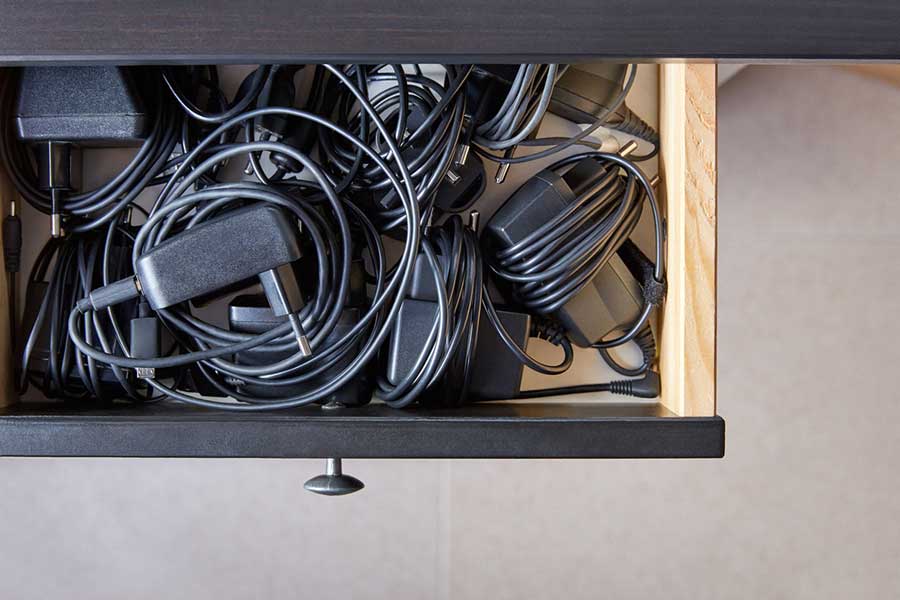
Most of us have a drawer or box with random electrical cables and connectors from devices we used to own. We’ve kept them ‘just in case’. Well, if you’re tackling the messy wires in your home, you may as well start here.
First of all, are there any wires in there that could be swapped for wires currently in use? If you have a mess of black wires hanging down against a white wall, for instance, do you have any white wires with the same connector type that you could use instead? They’ll certainly appear less obvious if they’re the same colour as your wall. Or are you using wires that are a bit too long, or short, and could you swap them for wires of a better length from your stash?
Next, consider which wires you can dispose of.
Let’s say you find a wire with a tiny micro-USB connector, and having just gone round your home labelling things you know you don’t own anything that needs a micro-USB charger. Get rid of it! If you buy something in the future that needs a micro-USB charger, it will come with that charger, you do not need to keep an old one.
But wait! You don’t want your wires to end up in landfill, right? You’re also probably aware that there are metals and things in wires that might or might not be useful, and might or might not be bad for the environment, right?
There is a way to recycle old electrical wires and we highly recommend doing so. There are loads of places where electrical cords, wires and connectors can be recycled, including at your local waste recycling centre, DIY shops and some community buildings like libraries. To find your local electrical wire recycling point, you could go to the Recycle Your Electricals website site and plug in your postcode to see where you can recycle wires locally.
Once you’ve recycled the wires you know you won’t need, pop any you want to keep into individual bags, label them with what type of wire they are, and put them back into your drawer or box. If you don’t have bags, wind up your wires and pop them inside toilet-roll tubes to keep them separate and stop them tangling together into a great big ball (again).
3. Streamline your cables
Turning your attention back to the cables currently in use - how do you hide electrical wires in your home?
You can fasten them to your walls, book cases, shelves or cupboards - whatever furniture they’re nearest - to make them straighter and more organised. To do this, you can use cable wire clips. These are little plastic hooks that will fit snugly around a wire, and you secure them in place by tapping in the small nail that comes with them. These are good for wires for your TV or other fixed appliances - things you know you won’t need to unplug and move around very often.
If you’re nervous about banging nails into your walls (especially if you’re a renter), there are stick-on versions of cable clips that can be applied and removed without causing any damage.
To hide the wires even more effectively, you could use something called ‘D-line micro decorative trunking’. This is a strip of plastic with a flat back that fits flush against the wall, and a curved front (so, if you cut it in half, it would look like a capital ‘D’). You slot your wires through the tube and attach the tube to the wall. It looks a million times neater than having a loose wire there, and all trunking can be painted to match your decor!
4. Group your cables
Once the visible wires are neatly wrangled into tubes or clips, you can turn your attention to the excess lengths of wires that are likely to congregate around your plug sockets. It’s very unlikely that your appliances have electrical cables that are the exact same length as the distance between your appliance and the electrical socket, so there are bound to be curls of wire that need to be managed and kept tidy. They’re the ones you keep having to kick out of the way when you sit at your desk, you know the sort.
If you have several wires all together (e.g. at the back of your PC), you could manually straighten them all and tie them together with a cable tie. Or use a velcro strap for more flexibility (they’re easier to remove and replace than having to cut through a cable tie every time you want to extract one wire). This can help keep them all in one place and look tidier than having several loose wires dragging across the floor.
There are cable tidy boxes that can be put to good use - these have lids, and gaps down the sides for the wires to enter the box. You can usually fit wires, plugs and even extension sockets into these, and they will keep everything squared away and out of sight.
For appliances you move around, or cables you might take out with you (e.g. phone chargers, laptop cables, electrical fan wires), you’ll need a less permanent solution to make your electrical wires look neat and tidy.
Most of these wires are likely to be kept in your bedroom, for charging your phone overnight and plugging in your laptop. If you have a bedside cabinet, have a look to see if there is a way to thread a plug extension lead inside. If so, you could keep most of your wires hidden inside your bedside cabinet drawer. Or spend a few pounds on a bedside storage basket or bag, which can hang off the side of your bed and keep all your electrical devices and their wires neatly together and within easy reach.
Or, have a look for cable sleeves. These are lengths of fabric or plastic that can be spread flat, but naturally curl up into a tight tube. Keep one by your bed and use it to wrap around your wires to keep them neat and tidy; it’s easy to add or remove wires when needed.
Why should you keep your cables tidy?
Your main reason for wanting to organise your wires at home is probably aesthetic - wires just don’t look nice, do they? They can make even the tidiest of homes look messy and really draw the eye.
Another really good reason for tidying your wires, though, is safety. Wires can create a trip hazard, and they can pose a risk of harm to pets and young children.
If you have electrical appliances with wires that you don’t use often, and have young children or bitey pets in the house, you might consider storing those items out of sight and out of harm’s way for a while. You could pop them into your loft or a cupboard, or you could use a self storage unit if you have access to one.
Many of our customers use self storage units to store excess belongings that they don’t have space for at home - to reduce clutter, and make room for the belongings they use every day. Things like Christmas decorations, sporting gear, bulky winter clothes, books and paperwork. If you think having a spare room or cupboard away from home might be useful, please get in touch and we can give you information about the size and prices of our self storage units, and where your most convenient store is located.
