

Maximising Small Spaces During the Summer Holidays
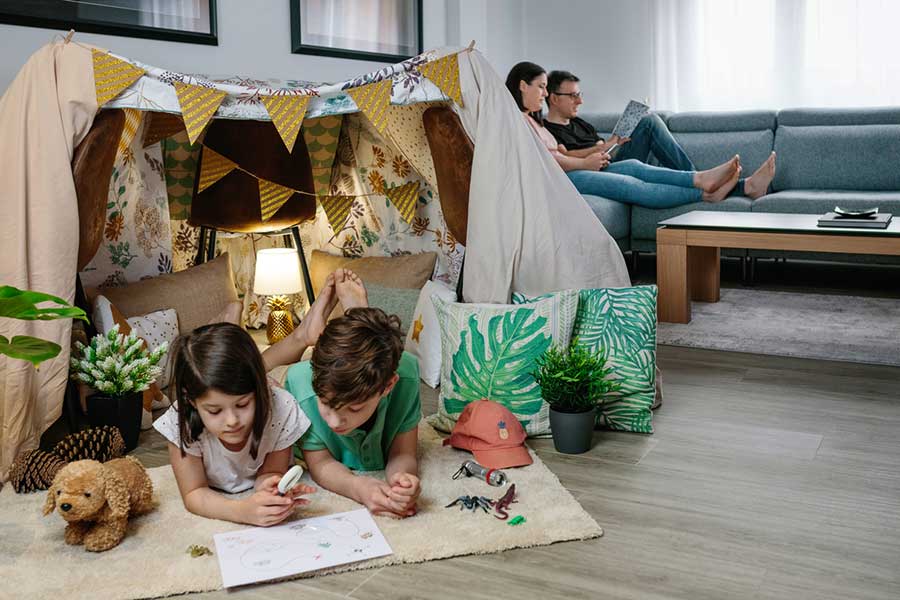
The school holidays are well underway, and you might have already forgotten what it’s like to have a routine or live in a house without chaos. When your children are at school, there is still a degree of chaos, as there always will be in a home with children, but it’s confined to after-school hours. The summer holidays hold no such respite, and you might already have discovered just how easy it is for the whole house to fall into disorder.
If you’re tired of saying ‘no’, sick of hearing your own voice repeating the same pleas for tidiness, and fed up of picking up after everyone, it’s time for a rethink. Here are our top tips for maximising the use of those small areas in your house so that everything has a place. These tips, combined with clear and simple boundaries for your children, should mean that maintaining that organisation isn’t all down to you.
1. Create flexible zones
Zoning your rooms is a good way to ensure that mess doesn’t spread indiscriminately across your whole house.
If you have young children, they will probably spend most of their time in the shared areas of your home, such as the sitting room. If their belongings (like books, toys and games) are in other rooms of the house, they will migrate here and those shared areas will quickly become cluttered.
Review the layout and space in your sitting room. Can you create a zone for activities here? Creating a mini room within a room, you can allocate that space as their play area. Use whatever works as boundaries for this new zone - small bookcases, toyboxes, cushions, or the side of your sofa and chairs.
Fill the zone with cushions or beanbags to sit on, with a crate or shelf of books will give them a mini reading nook. Add a folding table (one that can be attached to the wall and lie flat when not in use) and it transforms into a crafting or drawing area. The simple rule for your children is that their stuff stays in that zone!
2. Use portable storage
If space is limited, it’s helpful to be able to move activities around to more convenient locations. If your children are doing a jigsaw at the dining room table, but you need the table for dinner, someone is going to get cross! Use trays for games with small pieces, so that they can be easily moved to another location, or roll-up mats for jigsaws.
Carts and shelves on wheels are useful for the same reasons, and this kind of portable storage will help you to make sure you can all share the space in your home.
3. Make use of multi-use furniture
Folding and stackable furniture and storage are great for allowing flexible use of the space in your home. If the children want to spend a few hours creating a marble run or setting up a race track, open space on the floor can be created by moving everything to the side of the room, but if they want to do something creative like papier mache or painting, you need chairs and tables for them to work with.
Fortunately, there are plenty of places to buy folding furniture for small spaces. You could get a bookcase with a fold-up / fold-down desk, and a folding chair to store behind it when not in use. If your children love den building, you could invest in a modular play sofa, that can be used as a sofa in the evenings to watch a film together, and turned into a castle or a house to play in during the day.
Pop-up tents, tunnels and playhouses can also be loads of fun and are easy to tuck away behind the sofa when not in use.
4. Make storage super accessible
The aim of any storage for toys, games and crafts, should be that it’s easy for your children to access. Your children should be able to take out what they want to play with, to encourage independence, but they should also be able to put things away independently.
If you insist on having neatly organised drawers and cupboards, your children will be put off using them if it’s challenging to put things away neatly in a particular place. Aim instead for boxes with lids, cupboards with doors and child-height shelves with clearly labelled boxes. The boxes might look messy inside, but if the mess is inside the lidded box then it’s not on your floor, and that counts as a win!
Using stackable storage will save space in small areas of your home, but make sure your children can still access what’s inside each stacked box - can they be opened from the front? Put written labels on each box, or stick a picture of what’s inside for children who can’t read yet.
Create a rule that before one game / activity can be brought out, the last one has to be put away.
5. Rotate toys and activities
If you have more toys and activities than your children could possibly play with on any given day, consider storing some of them. You could pop them into a garage, shed or under-stairs storage area, or into a self-storage unit (see tip 8, below). Every week or two, swap out the toys that have been played with that week for ones that have been stored away, to introduce novelty and interest that might otherwise be waning. This is cheaper than buying new toys all the time!
6. Use vertical space
Floorspace might be at a premium, taken up by everyday furniture, so if you need somewhere to store and organise toys and games etc during the school holidays, look for ways to use your wallspace.
Organiser peg boards are great - you can hang pots filled with pens and paintbrushes, shelves and hooks. Or use hanging shoe storage on the back of doors to store small games and toys.
Board games and most toys take up a lot of room because they come in chunky cardboard boxes. If possible, empty them into fabric bags, label them with fabric pens, and make sure you keep the instructions with them! Then hang them on your peg board rather than take up space in a cupboard. It’s easier for your children to pack away games into bags than try to put everything neatly into particular slots inside the packaging.
7. Set up a garden room
If the weather is good enough to sit outside, set up a little play area on your patio or driveway where your children can play games and do crafts between games of football or swingball. A little table with benches and a sun umbrella, perhaps with drawers for crayons, chalks and paper, will help to keep them entertained for hours.
8. Declutter and make space
If there’s anything you don’t need to use over the summer holidays that’s taking up space in your home, pack it away and pop it into storage. If you don’t have space in your loft, under the stairs or in a shed (or are worried about things being damaged or damp in there), consider renting a self storage unit for a few weeks.
You could put excess toys in your unit if you’re rotating them (per tip 5 above), and you could also store things like Christmas decorations, winter clothing and other items you use only occasionally to save even more space.
Ask for help from your children in identifying any toys and games that they don’t play with anymore, and encourage them to donate them or sell them for some extra pocket money.
If you think that self storage would help you to keep your home organised and uncluttered during the school holidays, please get in touch and we can give you all the information you need on locations, prices and our flexible storage options.
And finally …
The advice above is likely to be most beneficial to you if you have young children. There will come a time when you miss stepping on Lego or having to pick up dozens of pieces of ‘artwork’ to find your dining room table, because your little mess monsters will become teenagers. Those teenagers will spend most of their time in their bedrooms, making a mess in there instead and hoarding all your crockery.
For your own sanity, you should probably just close the door to those rooms and ignore the mess. The rest of your house will be lovely and tidy!
