

School summer holiday chaos? How to keep your family and house organised
For most children, the summer holidays are an absolute blessing - six whole weeks of freedom, time at home, and fun! No more lessons! No more homework! For most teachers, the summer holidays are a blessed relief - six whole weeks of no marking, wrangling, negotiating, refereeing, or telling children to sit down and put their hands up if they want to speak.
For parents… well, the summer holidays are a bit of a mixed blessing. On the one hand, we don’t need to worry about arguments over whether homework has been / should be done, we can spend quality time with them without everyone being tired, and we don’t have to struggle through school run traffic every day. On the other hand, there’s no free ‘childcare’, so we either have to take time off work or pay for a summer scheme or childminders, and with no routine imposed on the children we have to create one that works for everyone.
Why do we have such long summer holidays?
There are lots of theories as to why UK children have such long summer holidays - the most popular being that it was because parents needed their children at home over the summer to help with farming work prior to the harvest.
There are other theories, though, including one that stems from the 18th Century ‘Grand Tour’, which saw privileged families exploring Europe for weeks at a time during summer.
Or one that says it was an American idea from the 19th Century, designed to give teachers and children a break to prevent children from suffering “nervous disorders”, and summer was the best time for that because it meant that children weren’t cooped up indoors during the hottest part of the year.
There are regular petitions and reports commissioned that say we should have shorter summer holidays (perhaps compensating for this by having longer half term holidays in February and October), but so far no major changes have been adopted or planned. So, assume for now that you’ll have six weeks to spend time with your children, keep them entertained, and try to keep your house from descending into chaos.
How do you keep calm and maintain a normal, tidy home, when faced with six weeks of full-time childcare?
How to keep your children organised
Without routine or order, the house can quickly descend into messy, disorganised chaos over the summer holidays. Children thrive on routine and, despite what they might (loudly) insist, they do like boundaries. Boundaries and clear, simple rules make them feel safe and calm.
Visual timetables
Many primary schools use visual timetables to help children anticipate changes or know what to expect; this reduces anxiety and creates a timeline of expectations and rewards (e.g. they will be expected to learn maths, and then they can go out to play). Secondary schools do the same, but with individual planners and written timetables.
Creating a routine or a visual planner for each week can help to give the children some structure and stop them (and you) from relying on screens to pass the time. These are easy to create, and should be tailored to the age of your children. Draw (or print) a simple table / grid, with Monday to Sunday along the top of the page and space underneath each day for you to write or draw that day’s activities. If there are jobs to be done, add those to each day they need to be done.
For instance, if you have a young child who isn’t yet able to read, draw (or print off) pictures of what you’ll be doing on any given day - a picture of swings for the park on Monday, a picture of a picnic basket on Tuesday, a box of popcorn for a trip to the cinema on Wednesday and so on. For older children, you can write these down instead.
Add jobs to any day where there is also a nice thing to do after their job is done. Jobs might be to practise some writing or maths, help with the dishes, read to a grown up, or tidy their room.
Alternatively, create a larger grid for the whole six weeks, so that your children can develop a better grasp of time and when to anticipate larger trips or treats such as a family holiday.
If you’ll be enlisting different people to look after your children during the holidays, pop a picture or name of that person on each day so that your children have the certainty and comfort of knowing who they’ll be with.
Create rules
Putting some simple household rules in place and keeping an organised house can prevent anarchy.
These don’t have to be onerous, and should be reinforced positively (i.e. when they are followed, reward or praise your children, rather than penalise or criticise them for not following them). The rules might be to put one toy away before taking out and playing with another, or to tidy away toys before going out to play.
Remember: if you create a rule, you have to enforce it, or your children will quickly learn to exploit any loopholes!
How to keep your house organised
Give your children (and you) a couple of days to just rest and unwind after the term ends. Then put in a bit of groundwork early in the holiday so that the rest of the time can be spent enjoying the fruits of your labour.
Have a toy clearout
With your children, sort through their toys and books to identify ones that they no longer play with or read because they’ve grown out of them, or they’re broken / damaged. Encourage compassion and charity in your children by explaining that there are children who don’t have toys or books because they don’t have enough money, and explain how charity shops work. Donate what they’ll part with, and recycle the broken toys at your local recycling centre.
Then sort the rest into piles - soft toys, Legos, puzzles, colouring books and pens, crafts, books etc.
Create accessible storage
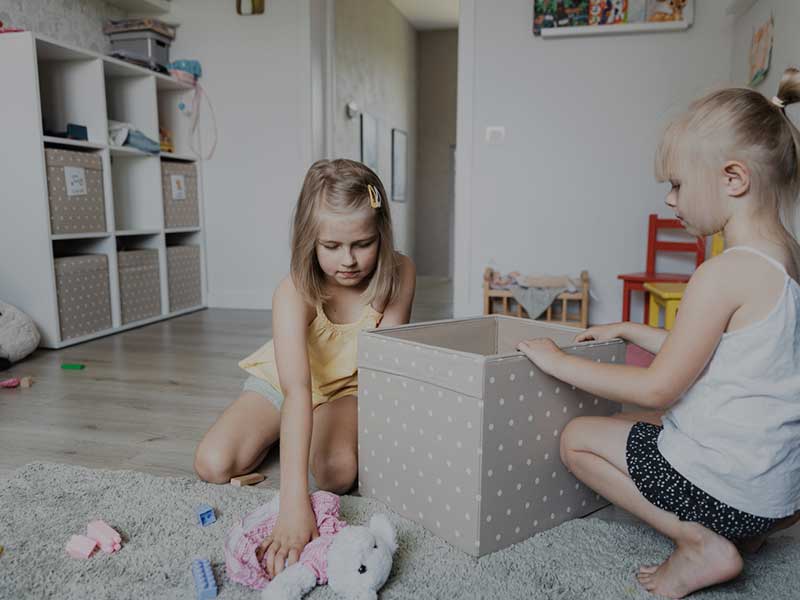
Put the toys into boxes or baskets that the children can easily access, sorted into categories as above. Don’t worry about them being put into the baskets / boxes in a particular order, the idea is that you want your children to be able to tidy up after themselves by ‘chucking’ things into the right basket after they’ve finished with them.
Put the books into piles or on a shelf that the children can easily reach and access. We have a few ideas on how to store children’s books if you’re stuck.
Clear plastic boxes are ideal because the children can see at a glance what’s in them, but if you don’t have those then label them (with pictures or words) so your children know what to put where. Clear drawer towers can be useful for smaller toys and crafts; for larger items like soft toys, you could use a storage ottoman or toy chest.
If your children know where everything is kept, they won’t need to rummage as much (so will create less mess) and will know where to put things when they’ve finished.
Refresh school supplies
Empty your children’s book bags and PE kit bags. Clean what needs cleaning and return it to the bag. Replace broken or empty pencils and pens, old rubbers, broken rulers and notebooks. Stock a drawer with spare stationery to replace items throughout next year.
Use ziplock bags or old pencil cases to group items together so you can see at a glance how many pencils / pens etc you have or need so you can keep them topped up.
Create activity zones
Prevent all the children’s ‘stuff’ from migrating freely around the house by assigning areas of the house to certain activities. For instance, create a reading nook for their books, with beanbags and blankets for cozy reading time. Keep your art and craft storage box / basket with all the paper near the dining room or kitchen table, since that’s where they’ll probably use it (also keep a stack of newspapers or table covering to hand!).
If your children have homework to do over the summer, make sure they have the stationery and books they need, but keep them out of sight until it’s time for them to work (according to their visual timetable). After all, when you’re not at work, you probably don’t like looking at something that reminds you of those emails you need to reply to, right?
Rotate toys, books and games
Children love novelty, and after a couple of weeks might insist that they have played with everything in the house and are bored. When sorting out their toys in the early part of the holiday, reserve some to bring out later on. Swap out the toys and games they’ve been playing with for new ones every couple of weeks to keep things fresh. The same applies to garden toys - you could swap out a swingball set for a basketball hoop, or skittles for hula hoops.
Store the toys that aren’t being used somewhere out of sight. Under a bed, in a wardrobe, in a cupboard - wherever you can access them easily. If you don’t have room at home, especially for larger items, think about renting a self storage unit or locker for a couple of weeks at a time. Lots of our customers use their self storage units to store unseasonal belongings over summer, such as Christmas decorations or thick winter clothing and bedding, and then add bits and bobs throughout the year when needed.
Involve your children
The key to getting cooperation from your children is to involve them in your decisions and the organisation of the house. Help them to understand why they’re giving away toys, or why they’re keeping some toys hidden for a couple of weeks. If you’re using self storage, show them pictures of our storage units so they know their toys and books will be safe, clean and dry.
If you would like to know more about how our self storage units work or would like to enquire about availability at a store in your area, please get in touch. If you decide to rent a unit with us, you could bring your children with you to put their toys safely away and enlist their help in locking your unit so that they know their things will be secure and that it will be easy for them to get their belongings back when it’s time to take them out.
